
What if choosing a delivery service was as simple as describing what you're sending?
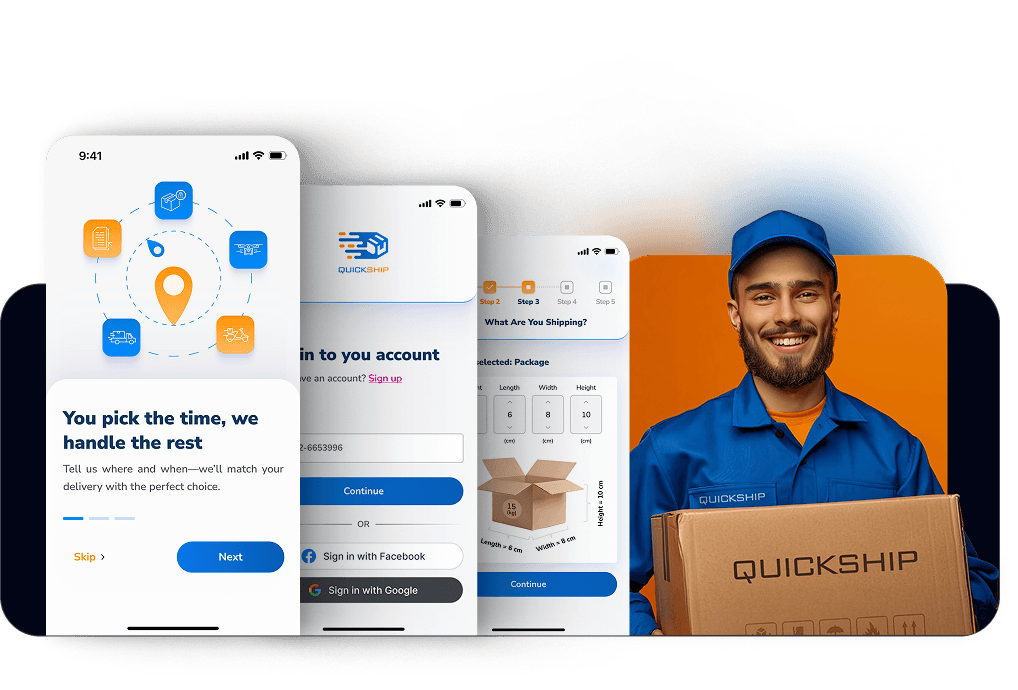

All-in-One Smart Delivery Platform
QuickShip is an AI-powered delivery platform that eliminates the cognitive burden of choosing between services. Instead of comparing apps, users simply describe what they're sending — and QuickShip handles the rest.
Different item types force users into different apps, rules, and flows which creates decision fatigue. QuickShip reframes the problem: instead of choosing how to deliver, users simply describe what they're sending, and the system decides the smartest way to deliver it.
Real-life pain
People just want to send something quickly without comparing apps, services, and conditions. Instead, they juggle multiple platforms, different UX patterns, and unclear expectations.
Business relevance
This fragmentation doesn't only frustrate users — it hurts conversions. Every extra decision point increases drop-offs and delays. Businesses lose potential orders simply because choosing feels "too hard."
Opportunity
What if users didn't have to choose the delivery method at all? What if they could simply describe what they're sending and the system recommended the smartest way to deliver it: fast, reliable, and transparent?
Wolt Drive
- Strong local delivery
- No cross-platform comparison
- Limited item types
DHL Express
- International focus
- Complex form flows
- No smart recommendations
Uber Connect
- Simple UX
- Limited to same-city
- No AI matching
“I just want to send a box. Why do I need to download three different apps to find the best option?”
— User interview, Tel Aviv — age 34
“Every time I need to ship something internationally I spend 20 minutes comparing prices and I still don't know if I chose right.”
— User interview, remote — age 28
Too many platforms, too little guidance
Users encounter 4-7 different delivery platforms for a single shipping need, with no clear way to compare them.
Decision fatigue is the real conversion killer
68% of users abandon a delivery flow when asked to choose between more than 3 options without clear guidance.
Trust is built through transparency
Users who understood why a service was recommended were 3x more likely to complete the booking.
Understanding the fragmentation
I started by mapping every touchpoint a user encounters when trying to ship something. The journey map revealed 12 decision points before a single order is placed — most of them unnecessary.
Reframing the problem
The key insight came from removing the service-selection step entirely. If the system knows what you're shipping, it can make the recommendation. Users shouldn't need to know the difference between courier types.
From 7 steps to 3
The new flow asks three questions: What are you sending? Where is it going? When do you need it there? Everything else is handled automatically.

Original: 7-step service selection flow

Redesigned: 3-question intelligent flow
Removing the service selection step reduced cognitive load and increased flow completion by an estimated 40%.

Onboarding — You pick the time, we handle the rest
The first screen sets the expectation immediately: this is not another comparison tool. The language is confident and benefit-focused.
- Warm illustration style to feel approachable, not corporate
- Single CTA — no choice paralysis on the entry point
- Progress indicator from step 1 to build momentum

Smart matching — What are you shipping?
Instead of a service list, users describe their item. The system uses this to pre-filter and rank options invisibly.
- Dimension inputs are chunked into width/height/length to feel less overwhelming
- Package preview updates in real-time as dimensions are entered
- Step indicator shows progress without revealing complexity ahead
This project taught me that the best UX decision is often the one you remove. By eliminating the service-selection step entirely, the product became both simpler and smarter. The challenge wasn't designing more — it was designing less, intentionally.
